Your car's check engine light glows orange on the dashboard and suddenly a simple commute becomes a source of anxiety. What does it actually mean? Is the engine about to fail, or did you forget to tighten the gas cap? The honest answer is: it depends - and knowing the difference could save you from an expensive tow, a destroyed catalytic converter, or a week of unnecessary worry.
The check engine light - technically called the Malfunction Indicator Lamp, or MIL - is the visible face of your vehicle's On-Board Diagnostics II system, universally known as OBD-II. Every passenger car and light truck sold in the United States since 1996 is required by federal regulation to carry this system. When any of dozens of engine management sensors detects a reading outside its acceptable range for long enough, the powertrain control module (PCM) stores a diagnostic trouble code (DTC) and switches on that orange glow. The code itself is your starting point, and reading it costs nothing at most auto parts stores.
This guide covers everything a car owner needs to know: what the two states of the light mean, how the underlying system works, the ten most common causes ranked by frequency, how to pull your own codes for free or near-free, what repairs typically cost, and exactly when it is safe to keep driving versus when you need to pull over immediately.
Solid Light vs. Flashing Light - The Single Most Important Distinction
When the check engine light comes on, your first job is to answer one question: is the light solid, or is it flashing?
A solid, steady check engine light means the PCM has detected a fault that is present or has occurred recently, but it is not an active emergency. The car is still running within parameters that allow you to drive carefully to a shop or auto parts store. Carefully means avoiding hard acceleration, keeping an eye on the other warning lights on the cluster, and not ignoring it for weeks on end. A steady light deserves attention within a few days to a week.
A flashing or blinking check engine light is an entirely different situation. Flashing means an active engine misfire is occurring right now - fuel is entering cylinders without being ignited and is being pushed raw into the exhaust stream. That raw fuel superheats the catalytic converter, which can destroy it within minutes of continued driving. Catalytic converter replacement is expensive; on many common vehicles it runs into the hundreds of dollars for parts alone, and some applications require manufacturer-specific converters that cost significantly more. If your check engine light is flashing, reduce speed immediately, avoid high RPM, and pull over as soon as it is safe to do so. Do not continue driving to see if the light clears on its own.
One additional note: if the check engine light appears alongside the oil pressure warning (the oil can icon) or the engine temperature warning, treat that combination as an emergency regardless of whether the CEL is solid or flashing. Those concurrent warnings can indicate a serious mechanical problem that requires an immediate shutdown to prevent catastrophic engine damage.
How the OBD-II System Works
Understanding the basics of OBD-II makes the diagnostic process far less mysterious.
Your PCM - the main computer managing fuel injection, ignition timing, emissions controls, and transmission operation on most vehicles - continuously monitors data from dozens of sensors. Intake air temperature, coolant temperature, throttle position, crankshaft position, oxygen content in the exhaust, fuel pressure, knock sensors - all of these feed the PCM data hundreds of times per second.
When a sensor reading, or a value calculated from multiple sensors, falls outside calibrated limits for a specified number of drive cycles, the PCM stores a five-character diagnostic trouble code and activates the MIL. Some codes require two consecutive failed drive cycles before the light illuminates; others trigger immediately on first detection of the fault.
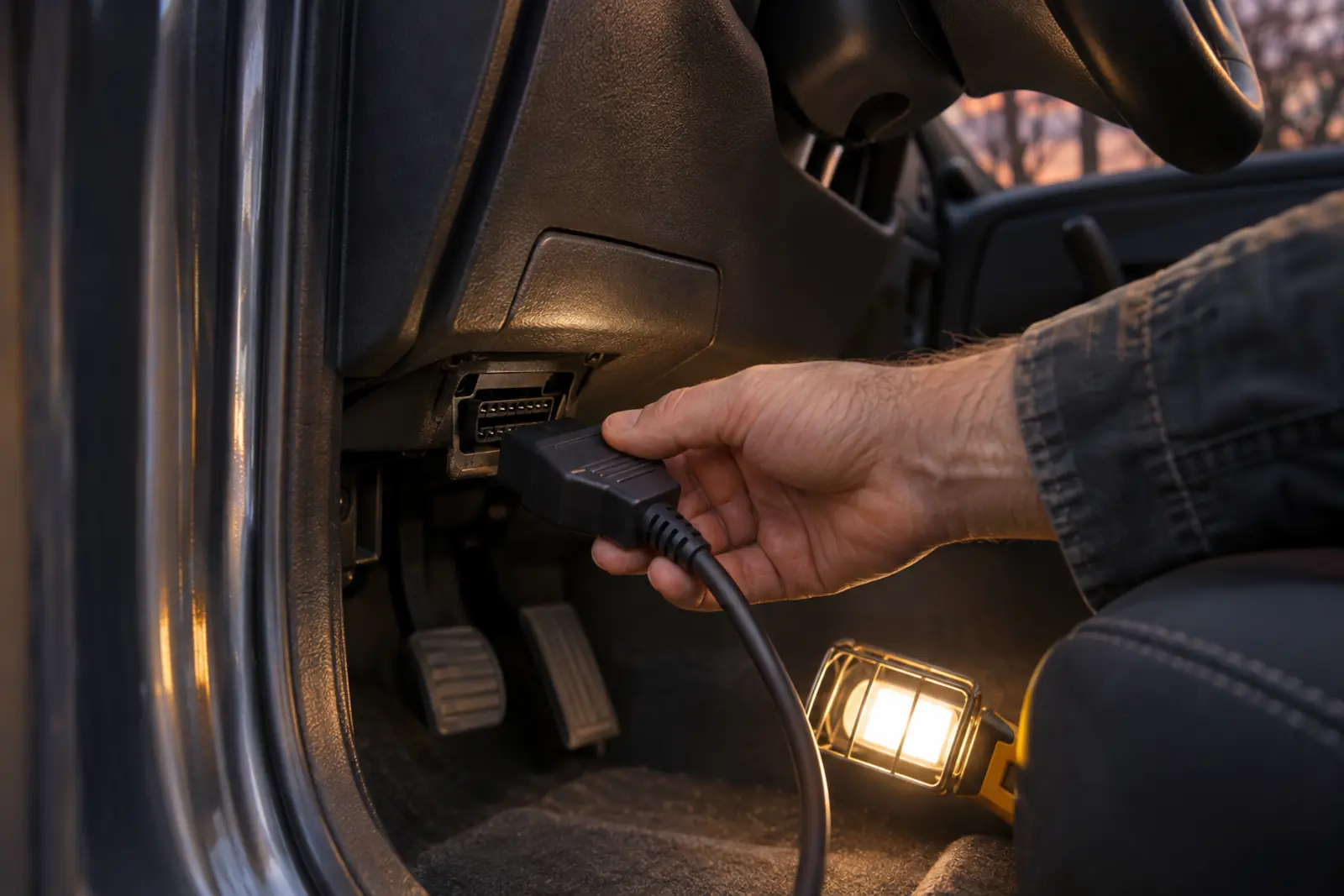
The OBD-II connector - a standardized 16-pin trapezoid port - is required by federal regulation to be located within reach of the driver, usually under the dashboard on the driver's side. Any OBD-II scanner plugs into this port and reads the stored codes. Because generic powertrain codes are standardized across all manufacturers under SAE J1979, a single scanner tool works on virtually any post-1996 vehicle sold in North America.
The 10 Most Common Check Engine Light Causes
Industry repair data consistently surfaces the same handful of problems as the most frequent check engine light triggers. Here they are in rough order of frequency, with the diagnostic codes most commonly associated with each.
1. Loose, Missing, or Damaged Gas Cap
This is the most anticlimactic check engine light cause - and also among the most common. The fuel system is a sealed evaporative emissions (EVAP) system designed to prevent fuel vapors from venting to the atmosphere. A loose or cracked gas cap allows vapors to escape, which the PCM detects as an EVAP leak and logs as codes in the P0440, P0442, or P0455 range.
Before doing anything else, tighten your gas cap firmly until it clicks. Drive normally for a day or two. If that was the cause, the light will often clear itself after one to three successful drive cycles. If the cap is cracked or the rubber seal is hardened and no longer seating properly, a replacement cap is inexpensive and available at any auto parts store.
2. Oxygen Sensor Failure
Oxygen sensors measure the amount of unburned oxygen in the exhaust before and after the catalytic converter. The PCM uses upstream O2 sensor data to fine-tune the air-fuel ratio in real time; downstream sensors monitor catalytic converter efficiency. A failing O2 sensor causes the engine to run rich or lean, reducing fuel economy and potentially damaging the catalytic converter over time. Codes typically fall in the P0130 to P0167 range, with letter and number suffixes identifying which exhaust bank and which sensor position is affected.
O2 sensor replacement is a moderate DIY task on many vehicles - the sensor threads into the exhaust pipe and requires a dedicated O2 sensor socket. Accessibility varies considerably by engine layout; some sensors are straightforward to reach, others require lifting the vehicle. Check a repair manual or a model-specific forum for the exact location on your vehicle before purchasing parts.
3. Catalytic Converter Failure
The catalytic converter reduces harmful exhaust emissions by converting hydrocarbons, carbon monoxide, and nitrogen oxides into less harmful compounds through chemical reactions on a platinum-group metal substrate. When it degrades - typically because of a preceding problem such as a bad O2 sensor, persistent misfires, or oil consumption that fouled the substrate - the PCM stores a P0420 (bank 1) or P0430 (bank 2) code indicating catalyst system efficiency is below threshold.
This is one of the more expensive repairs on this list, with costs varying widely by vehicle make, model, and whether an OEM or aftermarket unit is used. Always get at least two written quotes, and confirm that the shop will address the underlying cause before or alongside replacing the converter. Installing a new converter without fixing what destroyed the old one simply means doing the repair twice.
4. Mass Airflow Sensor Failure
The mass airflow (MAF) sensor sits in the intake air duct between the air filter box and the throttle body. It measures the volume of air entering the engine, and the PCM uses that measurement to calculate the correct fuel injection quantity. A dirty or failing MAF sensor sends inaccurate data, causing rough idle, hesitation during acceleration, and reduced fuel economy. Codes land in the P0100 to P0104 range.
Before replacing a MAF sensor, try cleaning it with dedicated MAF sensor cleaner spray - available at any auto parts store. Do not use carburetor cleaner or brake cleaner; both can permanently damage the delicate heated sensing wire or film element inside the sensor. Cleaning resolves the code in a meaningful percentage of cases at minimal cost.
5. Ignition Misfires - Spark Plugs and Coils
Misfire codes P0300 through P0308 are among the most common check engine light triggers. P0300 indicates a random or multiple cylinder misfire; P0301 through P0308 pinpoint the specific misfiring cylinder. The most common causes are worn spark plugs, a failed coil-on-plug ignition coil, or cracked spark plug wires on older vehicles with distributor-based ignition systems.
Spark plugs are a scheduled maintenance item. Many modern engines specify replacement at 60,000 to 100,000 mile intervals for iridium or platinum-tipped plugs - check your owner's manual for the manufacturer's specific interval for your engine. A single failed coil-on-plug ignition coil is extremely common on many four-cylinder and V6 engines; identifying the misfiring cylinder from the code and replacing only that coil is usually straightforward and well within DIY capability.
6. EVAP System Leaks Beyond the Gas Cap
The EVAP system extends beyond the gas cap to include a network of rubber hoses, a purge solenoid valve, a vent valve, and a charcoal canister that captures fuel vapors when the engine is off. Any leak in this network triggers EVAP codes. A smoke test - in which a technician introduces pressurized inert smoke into the sealed system and observes where it escapes - is the standard diagnostic method for locating leaks. Common culprits include cracked rubber hoses from heat cycling, a stuck-open purge valve solenoid, and a damaged charcoal canister.
7. Thermostat Failure
The coolant thermostat regulates engine operating temperature by controlling when coolant flows to the radiator. A thermostat stuck in the open position causes the engine to run below its optimal operating temperature for too long after a cold start, which the PCM detects by comparing coolant temperature sensor data against the expected warm-up curve for ambient conditions. The typical code is P0128. Running too cold increases fuel consumption, reduces heater output, and affects emissions performance. The thermostat itself is an inexpensive part on most engines; labor to access it varies.
8. EGR Valve Problems
The Exhaust Gas Recirculation valve routes a measured quantity of exhaust gases back into the intake manifold to dilute the incoming air-fuel mixture, which lowers peak combustion temperatures and reduces nitrogen oxide (NOx) emissions. EGR valves accumulate carbon deposits over tens of thousands of miles and can stick in the open or closed position. A stuck-open EGR valve causes rough idle and stalling at low speeds; a stuck-closed valve elevates NOx emissions and triggers a code. EGR-related codes vary by manufacturer but commonly fall in the P0400 to P0408 range.
9. Fuel Injector Issues
Dirty or failing fuel injectors disrupt the spray pattern of fuel into the cylinder, leading to incomplete combustion, rough idle, hesitation under acceleration load, and eventually misfire codes on the affected cylinder. Some injector performance issues respond to a professional fuel system cleaning performed through the fuel rail under operating pressure; others require physical injector replacement. A fuel injector balance test, available at professional shops using a lab-grade scan tool, identifies which cylinder's injector is underperforming before parts are ordered.
10. Battery and Charging System Problems
A weak battery or a failing alternator can cause supply voltage fluctuations that trigger sensor faults across multiple systems, sometimes illuminating the check engine light alongside the battery warning indicator. If your CEL appeared immediately after a jump-start, following a recent battery replacement, or after you disconnected the battery for any reason, the charging system is a likely contributor. Many auto parts stores test batteries and alternators at no charge as a customer service - take advantage of this before paying for a full shop diagnostic scan.
How to Read Your Own OBD-II Codes
You do not need to pay for a shop diagnostic appointment just to learn which code triggered the light. Two practical options are available to nearly every driver.
Option 1 - Free code reading at auto parts stores. AutoZone, O'Reilly Auto Parts, Advance Auto Parts, and NAPA Auto Parts locations in most areas offer free OBD-II code reading as a walk-in customer service. An employee plugs a reader into your OBD-II port, the stored codes display in seconds, and they typically provide a printout with a brief description. Call your nearest location first to confirm the service is available, then drive in. This is the fastest, cheapest starting point and requires no tools or technical knowledge on your part.
Option 2 - Purchase your own OBD-II scanner. A basic Bluetooth OBD-II adapter that pairs with a free or low-cost smartphone app typically runs between $20 and $60 - verify current prices at the time of purchase, as hardware prices shift. These adapters remain plugged into the OBD-II port permanently and allow you to check and clear codes any time without visiting a store. More capable handheld scanners with built-in screens provide additional features such as live sensor data streaming and freeze-frame data, which is invaluable for diagnosing intermittent faults that do not produce consistent codes. For the serious DIY mechanic, a mid-range scanner with live data capability is a worthwhile long-term investment that pays for itself quickly.
Decoding the Five-Character Code Format
Every OBD-II diagnostic trouble code follows a standardized five-character structure. Knowing how to read it narrows the fault to a specific vehicle system immediately.
- Character 1 (letter) - the system: P stands for Powertrain, covering the engine and transmission. B is Body. C is Chassis. U is Network or Communication. The overwhelming majority of check engine light codes begin with P.
- Character 2 (digit) - the code type: A 0 means the code is an SAE generic standard code that applies to all OBD-II vehicles regardless of manufacturer. A 1 means the code is manufacturer-specific and requires targeted research for your specific make.
- Character 3 (digit) - the subsystem: 1 = fuel and air metering. 2 = fuel injector circuit. 3 = ignition system or misfire detection. 4 = auxiliary emissions controls. 5 = vehicle speed and idle control. 6 = PCM inputs and outputs. 7 and 8 = transmission.
- Characters 4 and 5 (two digits) - the specific fault: These narrow the issue to the exact component or parameter within that subsystem.
To apply this directly: P0420 breaks down as P (powertrain) - 0 (SAE generic) - 4 (auxiliary emissions) - 20 (catalyst system efficiency below threshold, bank 1). Once you understand the structure, the code stops being a cryptic string and becomes a specific address within the vehicle's systems.
Typical Check Engine Light Repair Costs
Repair costs vary significantly by vehicle, geographic region, and shop. The figures below are rough ranges intended to set realistic expectations before your first conversation with a shop. Always get written estimates from at least two shops for any repair of meaningful cost, and confirm each estimate includes diagnosis, parts, and labor before comparing.
- Gas cap replacement: Typically under $25 for a replacement cap. Often no cost at all if the problem was simply a loose cap you re-tightened yourself.
- Oxygen sensor (one sensor, parts and labor): Commonly $150 to $400, depending on sensor location and vehicle model. Vehicles with four or more O2 sensors may need only one replaced.
- MAF sensor (parts and labor): Roughly $150 to $350 on most common vehicles; significantly less if a cleaning resolves the issue without replacement.
- Spark plugs (full set, parts and labor): $150 to $400 on most four-cylinder and six-cylinder engines. Engines with difficult access - some require intake manifold removal to reach the rear bank - run higher. A full plug replacement is one of the more achievable DIY jobs on many engines.
- Ignition coil (single coil-on-plug unit, parts and labor): $100 to $300 depending on vehicle and coil location within the engine bay.
- Thermostat (parts and labor): $150 to $350 on most vehicles; the part itself is often inexpensive, and most of the cost is labor to drain and refill coolant.
- Catalytic converter (parts and labor): Highly variable. Many common vehicles fall in the $400 to $1,500 range; vehicles with California-emissions certification, turbocharged engines, or European luxury brands can run significantly higher. Verify with current local quotes before budgeting.
- EVAP system repair: Ranges from under $30 for a gas cap to $100 to $250 for a failed purge valve solenoid to $200 to $600 or more for a charcoal canister, depending on location and vehicle.
Treat these figures as a starting-point orientation, not firm price expectations. Parts pricing fluctuates with supply availability, and labor rates vary substantially by region. A shop in a high cost-of-living metro area will charge meaningfully more per flat-rate hour than one in a smaller market.
When Is It Safe to Drive with the Check Engine Light On?
Here is a straightforward decision framework for the most common scenarios:
- Light is flashing or blinking: Stop driving as soon as it is safe to do so. Pull over, shut off the engine, and arrange a tow or call a shop for guidance. You are at risk of destroying the catalytic converter within minutes of continued high-RPM operation.
- Light is solid and additional warning lights are also on - especially oil pressure or temperature: Pull over and shut off the engine immediately. Do not restart and drive until the vehicle has been assessed by a technician.
- Light is solid, no other warning lights, vehicle drives and feels completely normal: You can typically drive carefully for a day or two to get to a shop or auto parts store for a code read. Avoid aggressive acceleration and monitor the vehicle closely for any change in behavior.
- Light is solid but the vehicle feels rough, hesitates, has unusual smells, or is producing visible smoke: Do not delay. Have the vehicle inspected promptly regardless of whether the light is solid or flashing.
The check engine light exists to alert you, not to paralyze you with anxiety or invite you to ignore it indefinitely. Treat it as actionable information: read the code, understand which system is affected, and respond proportionately to the severity of what you find.
Frequently Asked Questions
Will the check engine light turn off by itself?
Yes, in some cases. If the underlying fault clears - for example, you tighten the gas cap and the EVAP system passes its own self-tests on subsequent drive cycles - the PCM will extinguish the light automatically, typically after one to three successful drive cycles. However, if the underlying problem persists, the light stays on. Never assume a light that turned itself off means the problem is resolved; use an OBD-II scanner or visit an auto parts store to confirm no codes remain stored in the PCM.
Can I clear the check engine light code myself?
You can clear stored codes using an OBD-II scanner, and on some older vehicles by momentarily disconnecting the battery. However, clearing codes without fixing the underlying problem is not a solution - the code will return within a few drive cycles once the PCM re-detects the fault. Clearing codes also resets all OBD-II readiness monitors, meaning the vehicle will fail an emissions inspection until those monitors complete their self-tests, which typically takes several days of varied normal driving. Only clear codes after confirming the repair is complete.
Can I fail an emissions test with the check engine light on?
In virtually all U.S. states that conduct OBD-II-based emissions testing, an illuminated check engine light is an automatic failure - no further testing is performed once the inspector sees the light is on. Fix the fault first, clear the code, allow the readiness monitors to complete their self-tests over several drive cycles, then schedule your emissions inspection. Confirm your specific state's requirements with your local testing station, as procedures and model-year exemptions vary.
How many drive cycles does it take for the check engine light to clear after a repair?
It depends on which OBD-II monitor is involved. The PCM requires the relevant self-test to complete and pass at least once - sometimes twice - after the fault is cleared. A full drive cycle typically involves a cold start after the engine has sat for several hours, a gradual warm-up period, steady highway speed driving, and a deceleration phase. Drive the vehicle for several days with a mix of city and highway conditions, then check monitor completion status with a scanner or at an auto parts store before presenting for an emissions test.
My car just passed an emissions inspection but now the check engine light is on. Is this normal?
Yes, this is entirely possible and fairly common. Emissions inspections verify the state of the OBD-II monitors at one specific point in time on one specific day. Any new fault can develop afterward, at any mileage. A recent pass does not mean the vehicle is fault-free indefinitely; it simply means it met the standard on the day of testing. The two events are completely independent of each other.
Should I use a dealer or an independent shop for a check engine light repair?
For most check engine light repairs, a reputable independent shop with a professional-grade scan tool and a repair data subscription such as ALLDATA or Mitchell1 is entirely adequate and frequently less expensive than a dealership service department. The main exceptions are vehicles still under the manufacturer's bumper-to-bumper or powertrain warranty and faults requiring proprietary manufacturer diagnostic software that only factory-level tools can access. Ask any shop upfront what diagnostic tools and repair data resources they have available before committing to a paid diagnosis appointment.
If your check engine light is on and you want a professional read on the codes and your options before committing to a repair, most repair shops and many auto parts stores can read the codes for you.