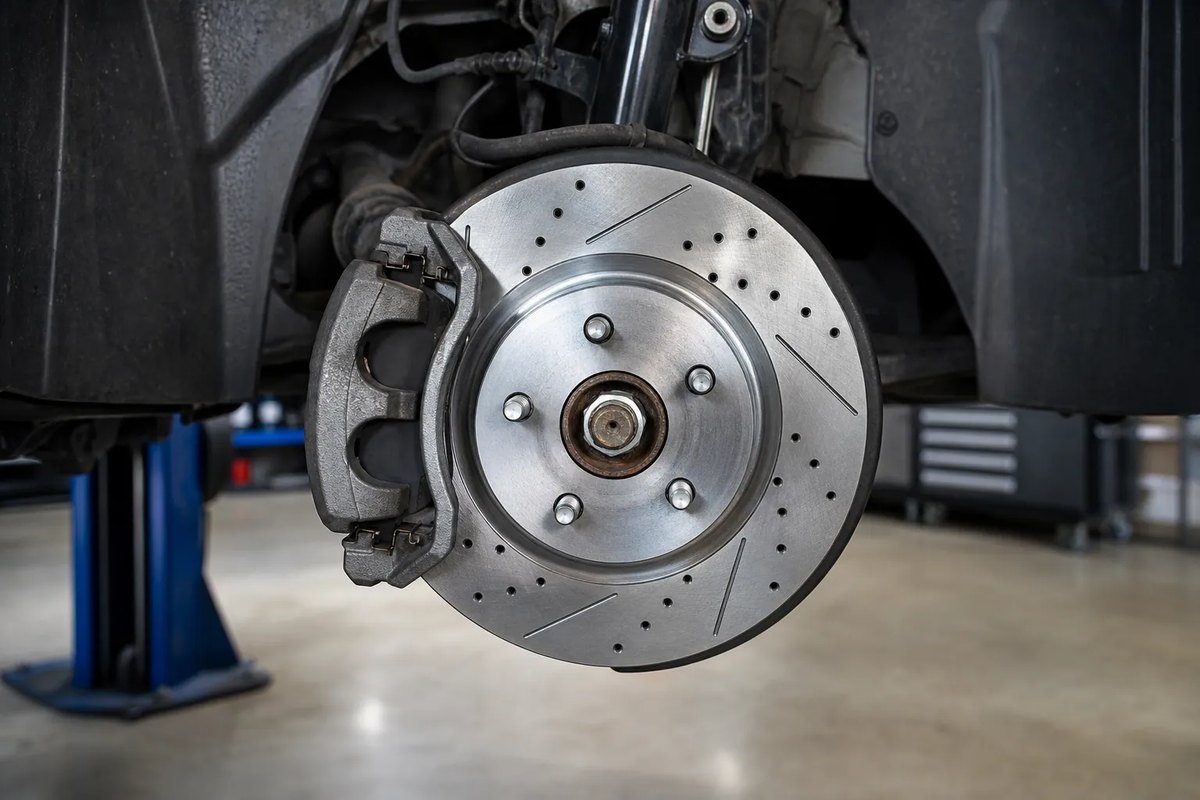
The five brake repair services most cars need over their life are brake pad replacement, rotor resurfacing or replacement, brake line inspection and repair, brake caliper service, and a brake fluid flush. Each one fixes a different wearing part, and each shows up as a different symptom: squealing or grinding, a pulsing pedal, a soft pedal, a pull to one side, or a longer stopping distance. Brakes wear gradually with every mile, so the change is easy to miss until something feels off.
Brake Repair Services at a Glance
- Brake pads: the friction material that wears down by design. Symptoms: squeal, grinding, longer stops.
- Rotors (and drums): the metal surface the pads or shoes press on. Symptoms: pulsing through the pedal, vibration, noise.
- Brake lines: carry hydraulic fluid to each wheel. Symptoms: a soft or sinking pedal, fluid near a wheel.
- Calipers: squeeze the pads against the rotor. Symptoms: pull to one side, uneven pad wear, a wheel that runs hot.
- Brake fluid: transmits pedal force. Symptoms: a spongy pedal under hard use; often no symptom until it is overdue.
Brake Pad Replacement
Brake pads press against the rotors to slow the car, and they are designed to wear down over time. Replacing pads on schedule, before they reach the metal backing, protects the rotors underneath and keeps braking predictable. Pads are generally considered worn out when the friction material is no longer thicker than the steel backing, according to the Wikipedia overview of disc brakes, and many pads carry a wear indicator, either a small metal tab that squeals or an electrical sensor that lights a warning on the dash.
For the signs that tell you pads are due, see the guide on when to replace brake pads. If the noise is a high-pitched squeal, squealing brakes: warning signs and causes explains what each sound usually means.
Brake Rotor Resurfacing or Replacement
Rotors are the discs the pads clamp onto. With heat and age they can wear unevenly, which you feel as a pulsing or vibration through the pedal when you slow down. Depending on their thickness, rotors can sometimes be resurfaced (turned on a brake lathe), but once they are too thin they should be replaced. A minimum thickness is normally cast into the rotor, and resurfacing is limited by it, since each pass removes metal. Smooth rotors restore steady, quiet braking.
Rotor resurfacing or replacement: how to decide
A lightly scored rotor can often work with new pads, while deeper scoring may need machining, and a rotor that is at or below its minimum thickness needs replacing, as the disc brake overview explains. Severe rust inside the ventilation slots of a vented rotor is another reason to replace instead of machine.
What feels like a "warped" rotor is often uneven pad material left on the disc, called disc thickness variation. The same source notes that drivers can feel pedal pulsation from variation of roughly 0.17 mm (0.0067 in). Overtightened or unevenly tightened lug nuts can also distort a rotor, so wheels should be tightened evenly, ideally with a torque wrench. A pulsing pedal is different from a shaking steering wheel at highway speed, which more often points to tires and suspension; see steering wheel shaking: causes and fixes.
Brake drum resurfacing on rear drum brakes
Many vehicles still use drum brakes at the rear. Instead of pads and rotors, they use shoes that press outward against the inside of a drum. A drum can be machined (turned) on a lathe, usually just enough to remove the ridge worn at its edge, but machining enlarges the drum, and a worn or damaged drum generally has to be replaced because oversized shoes are usually not available, according to the Wikipedia overview of drum brakes. When shoes are replaced, the springs and other hardware are normally replaced with them, since fatigued springs can break.
Brake Line Inspection and Repair
Brake lines carry hydraulic fluid from the master cylinder to each wheel. Because they sit under the car, they are exposed to moisture, road salt, and debris, and over the years they can corrode or develop small leaks. A leaking line is serious, since losing fluid means losing braking. Having the lines inspected and any damaged sections replaced keeps the whole system sealed and responsive. A pedal that sinks toward the floor, or fluid on the ground near a wheel, calls for a stop and a tow rather than a drive to the shop.
Brake Caliper Service
Calipers house the pads and squeeze them against the rotor. A caliper that sticks or seizes causes uneven braking, premature pad wear, and sometimes a pull to one side. Sticking is typically caused by dirt or corrosion blocking the caliper's sliding mechanism, a failed seal or boot, dried-out grease, or moisture; the disc brake overview lists reduced fuel economy, extreme heating of the disc, and uneven pad wear among the results. Cleaning, rebuilding, or replacing a failing caliper brings braking force back into balance across both sides of the axle. One wheel that is much hotter than the others after a drive is a common sign. If a worn wheel bearing is making noise at the same corner, wheel bearing noise and how to find the bad one helps separate the two.
Brake Fluid Flush
Brake fluid absorbs moisture from the air over time, which lowers its boiling point and can make the pedal feel soft under hard use. Common glycol-based fluids are hygroscopic, meaning they pull water out of humid air. Typical figures listed on Wikipedia's brake fluid page show the effect: DOT 3 boils at about 205 °C (401 °F) when fresh and about 140 °C (284 °F) once it holds 3.7% water, and DOT 4 drops from about 230 °C (446 °F) to about 155 °C (311 °F). Flushing and replacing the fluid at the interval your owner's manual gives removes that moisture and any grit, keeping the hydraulic system firm and reliable. Use the grade printed on the reservoir cap or in the manual.
Frequently Asked Questions
Which brake service is needed most often?
Pad replacement, because pads are the part designed to wear out. Rotors, calipers, lines, and fluid usually last longer, and their service intervals depend on the vehicle, the driving, and the climate. The owner's manual and a regular brake inspection tell you which one is due.
Can brake rotors be resurfaced, or do they have to be replaced?
Rotors can be resurfaced if, after machining, they will still be above the minimum thickness cast into them. Rotors that are already near that minimum, deeply scored, or badly rusted inside the vents should be replaced instead.
Can brake drums be resurfaced?
Yes, a drum can be turned on a lathe to remove edge wear, but machining makes the drum larger, and a worn or damaged drum generally needs replacing. Shoes are matched to the drum diameter, so the drum and shoes are checked together.
Why does brake fluid need to be flushed if it is not used up?
Because it ages rather than gets consumed. Glycol-based fluid absorbs moisture from the air, and water-contaminated fluid boils at a much lower temperature, which can make the pedal soft during hard braking, such as a long downhill.
Do I need all five services at once?
No. Each addresses a different part, and most are done as symptoms or inspections show a need. For how brake checks fit into a broader schedule, see a simple car maintenance schedule by mileage, and how to choose a trustworthy auto repair shop covers getting the work quoted and explained.